
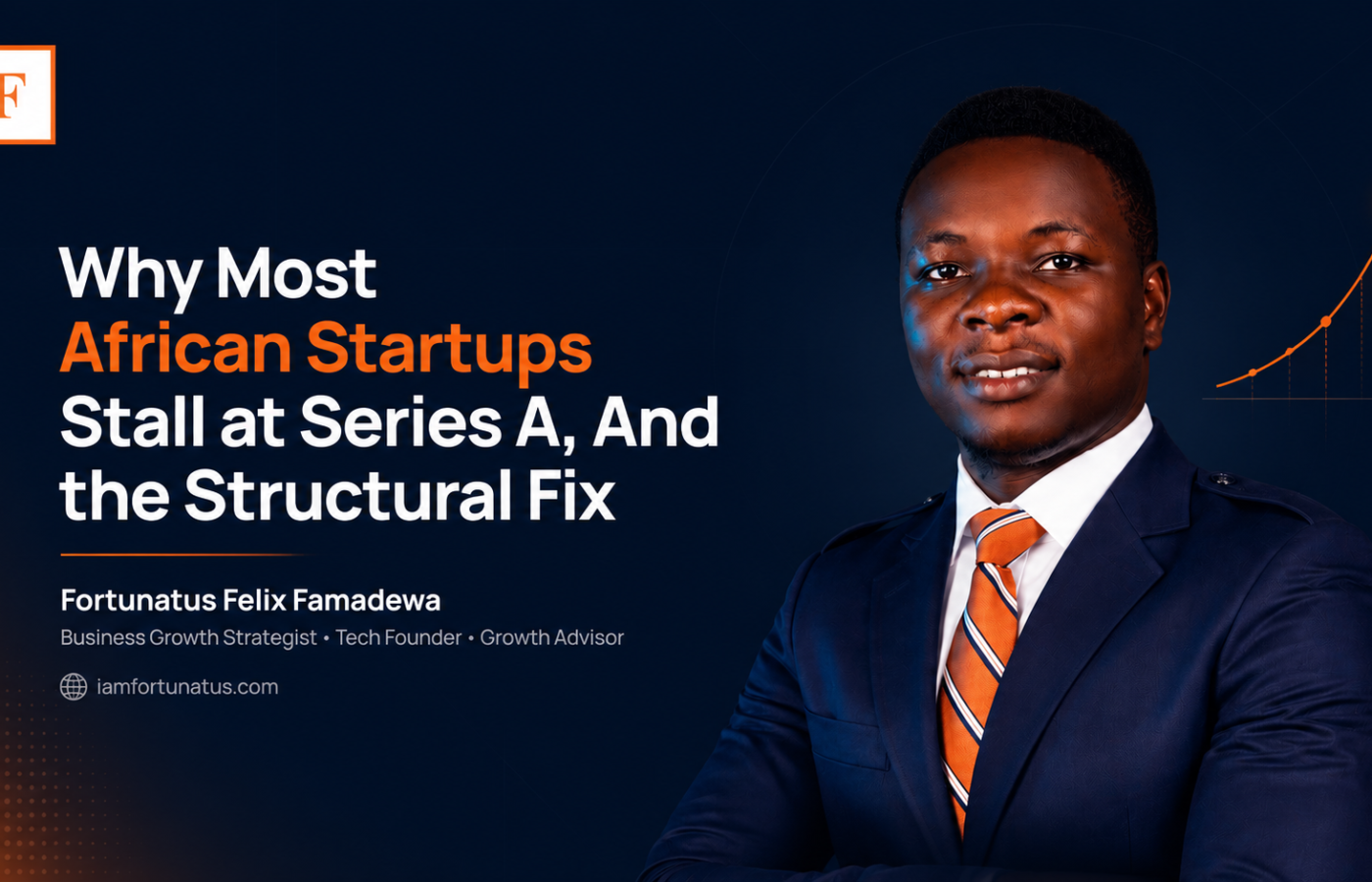
The problem isn’t funding.
It’s the absence of scalable systems built before the money arrives.
Most founders approach Series A with strong traction but weak infrastructure. Revenue is growing. The product works. Customers love it.
From the outside, everything looks ready.
But underneath, the company is being held together by the founder’s presence, intuition, and sheer force of will.
Then the money arrives.
And everything breaks.
The Illusion of Readiness
Series A is often treated as validation: proof that the business works and deserves to scale.
But in reality, Series A is not a reward for what you’ve built, it’s a stress test for how you’ve built it.
The capital doesn’t create problems. It exposes them.
What works at $50k/month or $200k/month starts to fail at a $1M+ scale. Decisions that were once intuitive now require systems. Execution that relied on proximity now requires structure.
And most startups aren’t ready for that transition.
The Four Structural Gaps
After working with founders across African markets at this exact inflection point, a pattern emerges. The companies that stall almost always suffer from the same four structural gaps.
Gap 1: No Scalable Operations
Everything runs through the founder.
Decisions, approvals, hiring, and escalation; every critical path leads back to one person. There are no documented processes. No clear ownership layers. No operational backbone.
At an early stage, this feels like speed.
At scale, it becomes the bottleneck.
As the team grows, confusion compounds:
- Who owns what?
- What does “done” look like?
- How are decisions made?
Without structure, output doesn’t scale with headcount. It slows down.
The founder becomes the system, and systems don’t scale if they depend on a human.
Gap 2: No Revenue Architecture
Revenue exists, but it isn’t engineered.
It came from hustle:
- Founder-led sales
- Personal relationships
- Opportunistic deals
There’s no repeatable acquisition engine. No defined funnel. No predictable conversion motion.
So when investors ask, “How do you 5x this?”, there’s no clear answer, only more effort.
And effort doesn’t scale linearly.
A real revenue architecture answers:
- Where do customers come from consistently?
- What is the cost to acquire them?
- What converts them and why?
- How do we make this repeatable without the founder?
Without this, growth plateaus no matter how much capital you deploy.
Gap 3: No Distribution System
Customer acquisition is fragile.
Most startups depend heavily on one of three things:
- A single marketing channel
- Founder visibility or personal brand
- Word-of-mouth within a narrow network
This works, until it doesn’t.
Channels saturate. Attention shifts. Growth slows. And suddenly, there’s no second engine to rely on.
In African markets especially, distribution is not a plug-and-play layer. It requires intentional design:
- Offline + online integration
- Local partnerships
- Trust-building mechanisms
- Last-mile access
Without a system, distribution remains inconsistent, and inconsistency kills scale.
Gap 4: No Execution Discipline
Strategy lives in the founder’s head.
The team is busy, but not aligned. Work is happening, but outcomes aren’t clear. There are meetings, but no measurable progress.
You’ll hear phrases like:
- “We’re working on it”
- “We’re close”
- “We’re figuring it out”
But there’s no:
- Clear ownership
- Defined metrics
- Regular accountability loops
Execution becomes reactive instead of intentional.
And at scale, lack of discipline compounds faster than lack of talent.
Why This Happens
These gaps aren’t caused by incompetence. They’re a natural byproduct of how startups are built.
Early-stage companies are optimized for survival:
- Speed over structure
- Intuition over systems
- Flexibility over clarity
Those traits are advantages at the beginning.
But they become liabilities at scale.
The mistake is assuming what got you here will get you there.
It won’t.
The Structural Fix
The solution isn’t to “work harder” after raising capital.
It’s to re-architect the company before scale forces you to.
That means:
1. Build operational systems early
- Document workflows
- Define ownership
- Create decision frameworks
- Reduce dependency on the founder
2. Engineer revenue, don’t chase it
- Design a repeatable acquisition funnel
- Track conversion metrics rigorously
- Separate founder-led sales from scalable sales
3. Treat distribution as a core asset
- Diversify acquisition channels
- Invest in local infrastructure
- Build partnerships that extend reach
4. Install execution discipline
- Set clear KPIs across teams
- Establish weekly accountability rhythms
- Align strategy with measurable outcomes
This is not “corporate overhead.”
This is what allows speed to continue at scale.
The Real Shift
The transition from Seed to Series A is not just about raising capital.
It’s about shifting from:
- Founder-driven → System-driven
- Effort-based growth → Engineered growth
- Reactive execution → Disciplined execution
The startups that make this shift don’t just survive Series A.
They use it as a launchpad.
The Bottom Line
Capital amplifies whatever already exists in your business.
If you have strong systems, it accelerates growth.
If you don’t, it accelerates chaos.
Most African startups don’t stall at Series A because the opportunity isn’t there.
They stall because the structure isn’t.
Fix the structure, and scale stops being fragile.
Growth without structure is not an opportunity. It’s a delayed collapse.
[leadlock_download id=”213″ form=”1″]
Ready to fix this in your business?
Get a Growth Audit→