
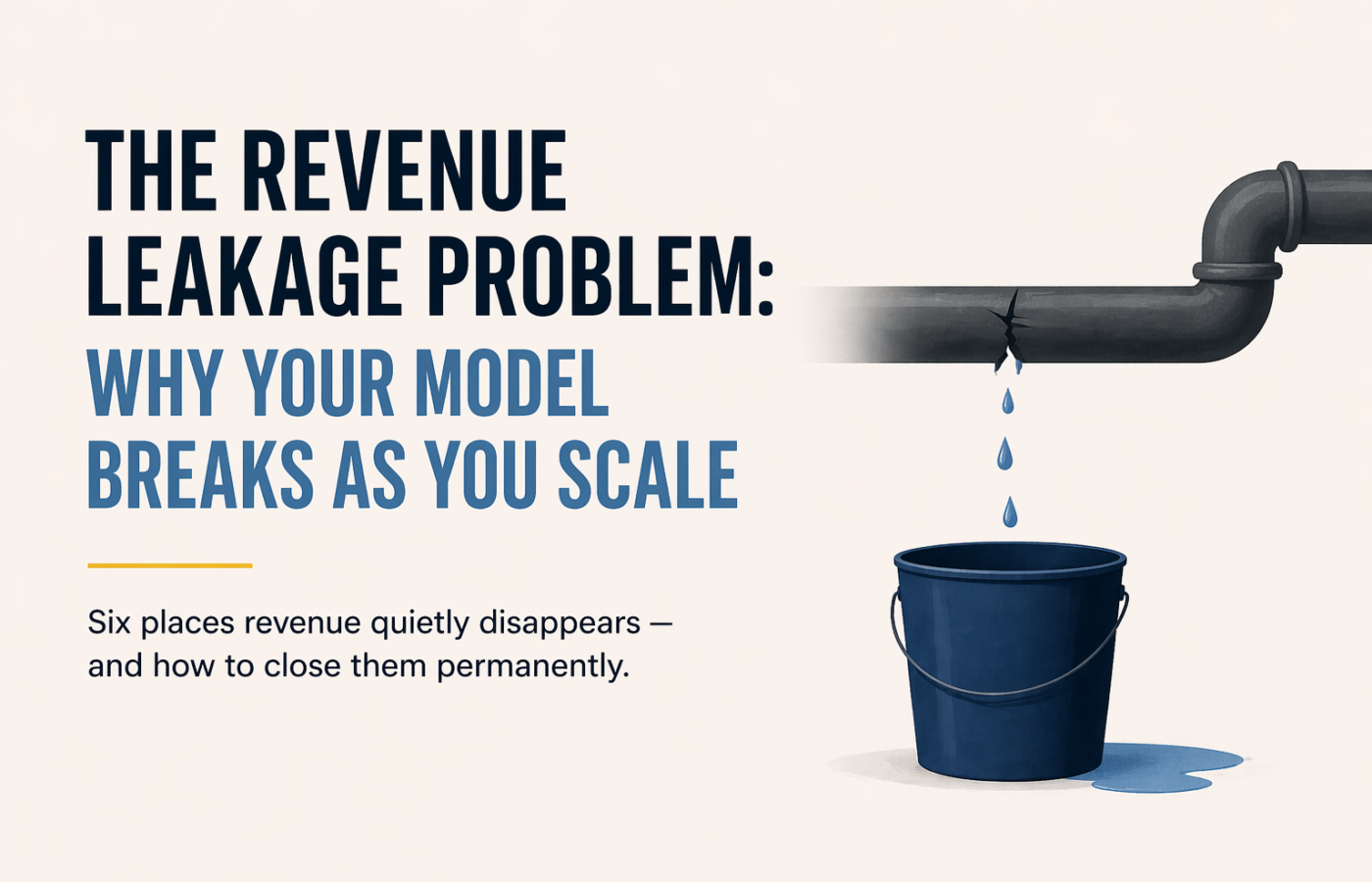
Six places revenue quietly disappears and how to close them permanently.
Most founders think they have a growth problem.
They don’t.
They have a leakage problem.
So they push harder on acquisition. More ads. More sales hires. More campaigns.
But scaling a leaking system doesn’t create growth.
It amplifies inefficiency.
Before you pour more customers into your funnel, you need to fix what’s already broken inside it.
Because right now, revenue is slipping through cracks you don’t even see.
The Hidden Cost of Leakage
Revenue leakage is dangerous because it’s invisible.
It doesn’t show up as a dramatic drop. It shows up as:
- Slower-than-expected growth
- Lower margins
- “We should be doing better” conversations
Individually, each leak feels small.
Collectively, they kill scale.
Here are the six most common places it happens.
1. Pricing That Undervalues Your Offer
You are almost certainly undercharging.
Not slightly significantly.
Most founders price based on:
- Fear of losing customers
- Competitor benchmarks
- What “feels reasonable”
Almost none price based on value delivered.
The result? You acquire customers but leave money on the table every single time.
And here’s the deeper problem: underpricing compounds.
When you scale:
- You attract more price-sensitive customers
- Your margins shrink
- You limit your ability to reinvest in growth
Fixing pricing later is also painful. Customers resist increases. Contracts lock you in.
Underpricing isn’t just lost revenue; it’s a structural ceiling on your business.
2. No Upsell or Expansion Revenue
Most companies treat a closed deal as the finish line.
It’s actually the starting point.
Your existing customers are your highest-leverage growth channel:
- They already trust you
- They’ve already paid you
- They’re easier to sell to than new prospects
Yet many businesses have:
- No expansion path
- No tier upgrades
- No add-ons or cross-sells
So revenue resets to zero after every sale.
This forces you into a constant acquisition treadmill, always chasing new customers just to grow.
Strong companies grow within their customer base.
Weak ones constantly replace it.
3. Churn Without Recovery
Churn is not just a retention problem.
It’s a revenue destruction engine.
Every customer who leaves takes:
- Their current revenue
- Their future lifetime value
- Potential referrals
But the real issue isn’t churn itself; it’s the lack of a recovery system.
Most startups:
- Don’t track why customers leave
- Don’t attempt structured win-back campaigns
- Don’t intervene before churn happens
They accept churn as a cost of doing business.
It’s not.
It’s preventable, measurable, and often reversible if you design for it.
4. Inconsistent Conversion
Your conversion rate should not depend on who is selling.
But in most early-stage companies, it does.
Founder closes at 40%.
Sales rep closes at 15%.
Another rep closes at 5%.
Why?
Because there is no system, only individual skill.
No standardized:
- Messaging
- Qualification criteria
- Sales process
- Objection handling
So performance varies wildly.
This creates two problems:
- You can’t predict revenue
- You can’t scale your sales team effectively
A scalable business doesn’t rely on heroes. It relies on systems.
5. Unmonitored Discount Patterns
Discounting feels harmless in the moment.
Close the deal. Keep the customer happy. Move fast.
But untracked discounts quietly erode your business.
Over time:
- Margins shrink
- Pricing integrity collapses
- Customers learn to negotiate every deal
And because discounts aren’t monitored systematically, no one realizes how much revenue is being lost.
What starts as flexibility becomes structural leakage.
If you don’t control discounting, it controls your margins.
6. No Referral System
Referrals are the highest-quality customers you can get:
- Higher trust
- Lower acquisition cost
- Better retention
Yet most companies treat referrals as luck, not a system.
They hope customers will recommend them.
Hope is not a strategy.
Without a structured referral engine:
- You miss out on zero-cost acquisition
- You fail to compound trust
- You leave network effects on the table
Every satisfied customer who doesn’t refer you is a missed growth opportunity.
Why This Breaks at Scale
At small scale, you can get away with leakage.
At large scale, you can’t.
Because leakage compounds:
- Underpricing multiplies across more customers
- Churn erases larger revenue bases
- Conversion inefficiencies waste bigger pipelines
So instead of growth accelerating with scale, it stalls.
Not because demand isn’t there.
But because the system can’t hold it.
The Fix: Build a Revenue System, Not Just Revenue
You don’t fix this by working harder.
You fix it by designing systems.
1. Re-anchor pricing to value
- Test higher price points
- Segment customers by willingness to pay
- Align pricing with outcomes delivered
2. Design expansion paths
- Introduce tiers, add-ons, and upgrades
- Map customer growth journeys
- Monetize success, not just acquisition
3. Install churn prevention and recovery
- Track churn reasons
- Trigger intervention before cancellation
- Build win-back campaigns
4. Standardize conversion
- Define a repeatable sales process
- Train against it
- Measure conversion at every stage
5. Control discounting
- Set clear discount rules
- Track discount impact on margins
- Require justification for exceptions
6. Systemize referrals
- Ask at the right moment
- Incentivize where appropriate
- Make referrals easy and trackable
The Real Insight
Growth is not about adding more.
It’s about losing less.
When you close revenue leaks:
- Your margins improve
- Your growth compounds
- Your model becomes predictable
Then—and only then—does acquisition scale efficiently.
The Bottom Line
Most businesses don’t need more customers.
They need to stop losing the value they already create.
Fix the leaks first.
Then scale becomes not just possible but inevitable.
Ready to fix this in your business?
Get a Growth Audit→